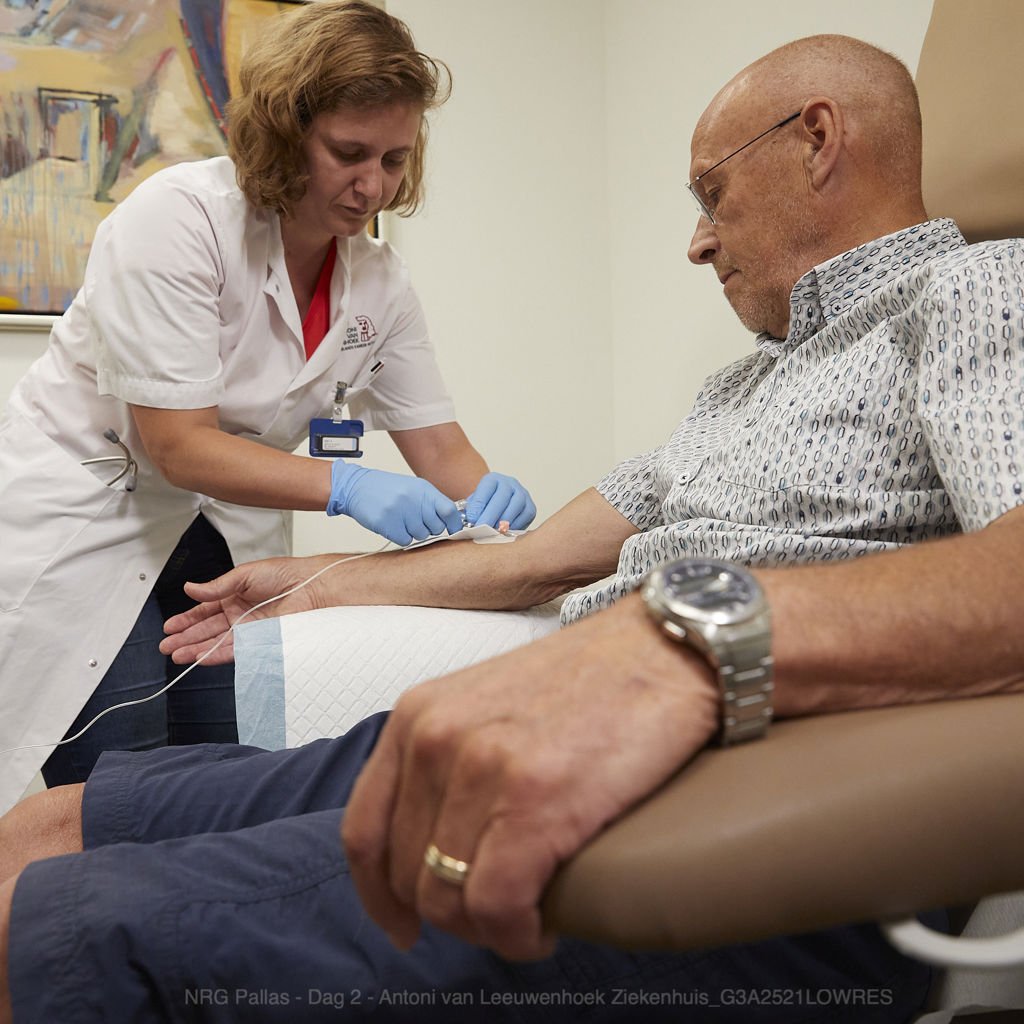
Medical isotopes at The Netherlands Cancer Institute

The Netherlands Cancer Institute is a hospital specialised in cancer and research institute. The doctors at The Netherlands Cancer Institute help hundreds of cancer patients every day. They carry out diagnostic assessments and provide appropriate therapies.
Prostate cancer is among the most prevalent malignancies. Patients diagnosed with this condition can benefit from the expertise of the Nuclear Medicine Department at the Netherlands Cancer Institute. A commonly employed therapeutic agent is Lutetium-177, a medical isotope that plays a pivotal role in targeted radionuclide therapy for prostate cancer.

"A novel mechanism of action..."
The Nuclear Medicine Department at the Netherlands Cancer Institute works in close collaboration with the Oncology division. Following diagnostic evaluation, the oncologist formulates an individualised treatment plan. Traditionally, this includes systemic therapies such as hormone therapy and chemotherapy. Recently, Lutetium-PSMA radioligand therapy has been incorporated as an additional treatment modality.
"For a long time, we have been anticipating a therapeutic option with a completely different mechanism of action. Lutetium-PSMA therapy has successfully addressed this need."
— André Bergman, Medical Oncologist at the Netherlands Cancer Institute, featured in the video below.
Watch the video: Medical Isotopes & The Netherlands Cancer Institute

"... with several physicians, nurses, and healthcare professionals"
For patients diagnosed with prostate cancer, the treatment journey can be complex. At the Netherlands Cancer Institute, the Nuclear Medicine Department works in close collaboration with multiple specialists.
"Several physicians, nurses, and allied healthcare professionals meet to discuss the optimal treatment strategy for each patient. Together, we review imaging studies, laboratory results, and the patient’s clinical status to determine eligibility for specific therapies."
- Michelle Versleijen, Nuclear Medicine Physician at the Netherlands Cancer Institute, featured in the video above.
Lutetium – What Is It?
Lutetium-177 is a medical isotope widely used in nuclear medicine for targeted cancer therapy. It emits beta radiation (electrons, which induce cell death) and low-energy gamma radiation (photons, which enable imaging). This isotope is linked to a carrier molecule that selectively binds to cancer cells, ensuring that the radiation is delivered directly and locally to the tumour site.
The therapeutic applications of Lutetium-177, known as radionuclide therapy, are primarily focused on the treatment of metastatic prostate cancer (via PSMA-targeting) and certain neuroendocrine tumours (NETs). The goal of this therapy is to inhibit tumour growth, improve quality of life, and extend survival, while minimising damage to surrounding healthy tissue.

In collaboration with

"30.000 per dag"
Every day, medical isotopes produced in the reactor in Petten are of critical importance to more than 30,000 people worldwide. These isotopes form the foundation of nuclear medicines and are essential for diagnosing and treating conditions such as cardiovascular diseases and cancer.